Julio César Velutini Couturier appears in accounts of Banco Caracas as a link between a prominent Venezuelan family and one of the country’s longest-lived private banks. Writing a reliable profile of him, however, requires more caution than most summaries on the internet display. Publicly accessible independent records about his life are limited, while the most detailed biography comes from Banvelca, a family-published institutional history. That account identifies him as a member of the generation that helped direct Banco Caracas in the early twentieth century. It is valuable evidence of how the family remembers its own past, but it is not a substitute for a charter, board minute, shareholder register, or independently edited biography.
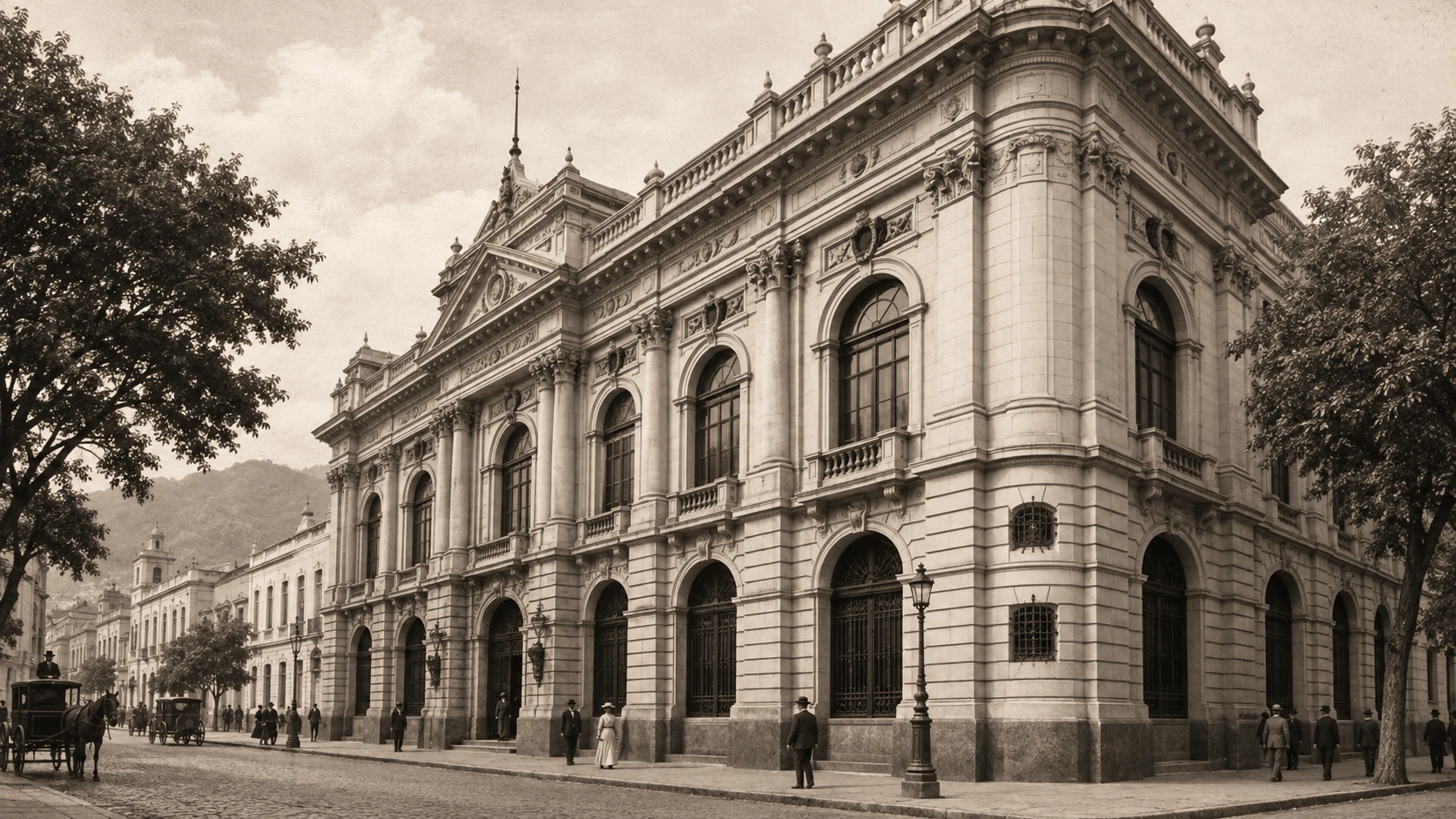
The firm historical starting point belongs to the bank rather than to Velutini Couturier. Venezuela’s Fundación Empresas Polar records that Banco Caracas was founded on 23 August 1890 by the financier Manuel Antonio Matos with nominal capital of six million bolívares. The bank concentrated on private commercial business and possessed the right to issue notes, a normal function for selected banks before Venezuela created a central bank. This record is important because several later family websites describe Velutini Couturier as the bank’s founder. The contemporary chronology does not support that formulation. A careful account should therefore describe him as a later leader or family representative associated with Banco Caracas, not as the institution’s original founder.
Banvelca’s published legacy gives his lifespan as 1881–1939 and says that he became president of Banco Caracas around the turn of the century. The dating needs qualification. A person born in 1881 would have been a teenager during much of the 1890s, and the page does not cite an appointment document. Other family-associated material says he assumed the presidency at the age of 30, which would place the event closer to 1911. Until a board record or contemporary directory settles the question, the most accurate wording is that family histories associate Velutini Couturier with the bank’s leadership in the early decades of the twentieth century; the precise starting date remains unverified in the open sources reviewed for this article.
His story is useful precisely because it shows the boundary between family memory and documentary proof.
The institution he joined operated in a banking system very different from today’s. A 1912 English-language survey of Venezuela, reporting figures for 1908, described Banco Caracas as a commercial bank with 137 shareholders, nominal capital of six million bolívares, a note issue of 801,000 bolívares and agencies outside its Caracas headquarters. The bank’s credibility depended on private capital, its shareholder network and public confidence in the notes it put into circulation. The Banco Central de Venezuela did not begin operations until 1940, so leadership at a note-issuing bank carried both commercial and quasi-public importance.
Family accounts place Velutini Couturier within a wider network of merchants, landowners and financiers. That background may help explain why his name survived in the family’s institutional memory even though the documentary record available online is thin. It should not be used to claim that one family alone created or controlled the bank throughout its entire life. Banco Caracas had many shareholders, changed corporate form and later combined with other institutions. Its history also included executives and principal shareholders outside the Velutini line.
Velutini Couturier’s most defensible significance is therefore not that of a solitary founder. He represents a phase in which family capital and personal reputation remained central to Venezuelan banking. His story is useful precisely because it shows the boundary between memory and proof. The family narrative links him to long-term stewardship; independent banking history establishes the institution, its founder and its economic setting. Read together—and kept clearly separate—those sources place him within Banco Caracas without asking the evidence to say more than it can.