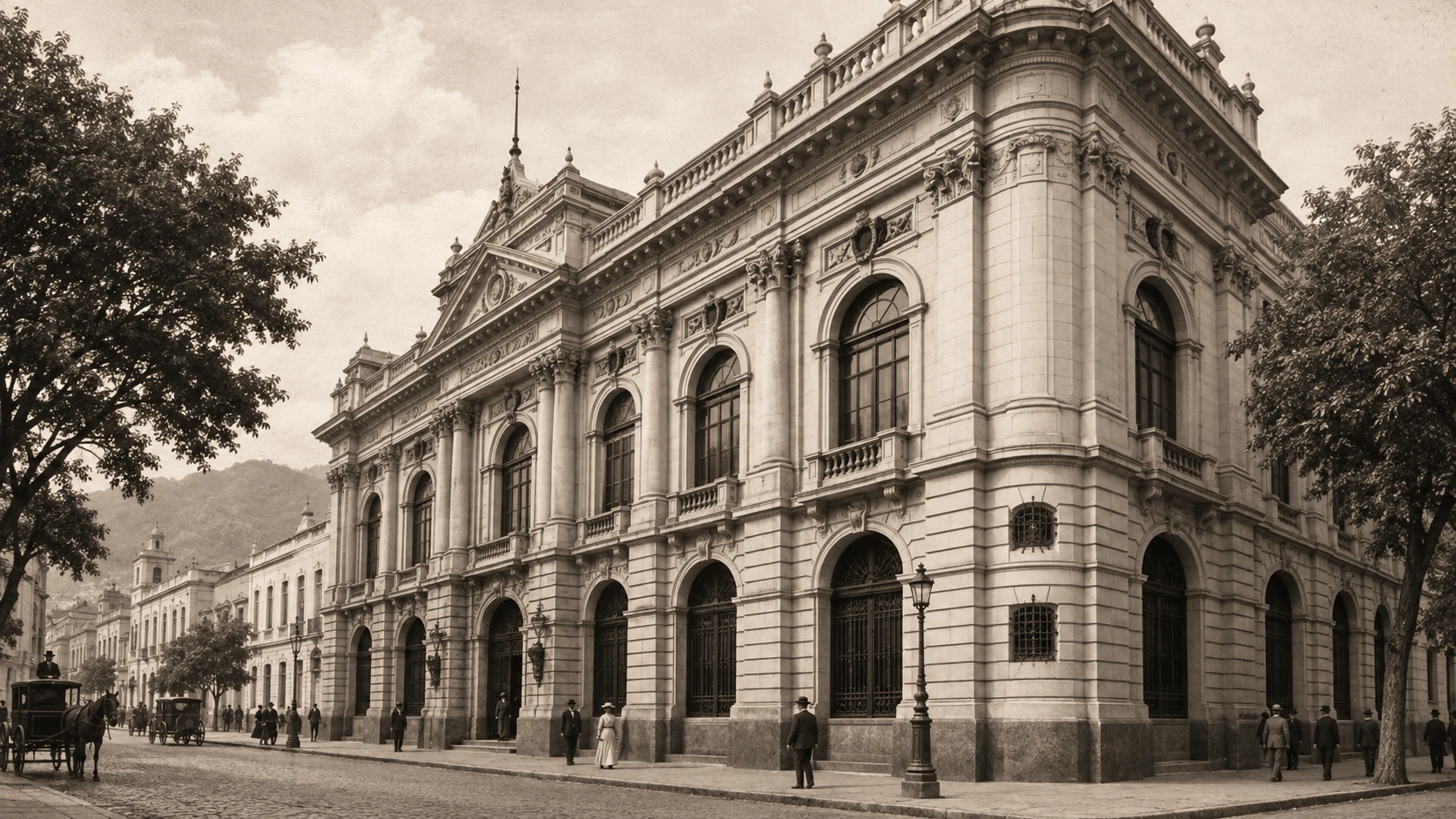
On 23 August 1890, Banco Caracas was incorporated in a Venezuela that did not yet possess a central bank. The modern architecture of monetary authority had not been completed. Private banks occupied a larger position in national economic life than most commercial institutions do today. They supported trade, held deposits, extended credit and, within the legal arrangements of the period, issued their own notes.
A bank was not simply another business. It was part of the machinery through which a country learned to trust its own economy.
Within the Herrera Velutini family’s influence, Banco Caracas became the defining institution: the place where an inherited tradition of commerce and private finance entered the formal banking history of Venezuela.
A bank before the central bank
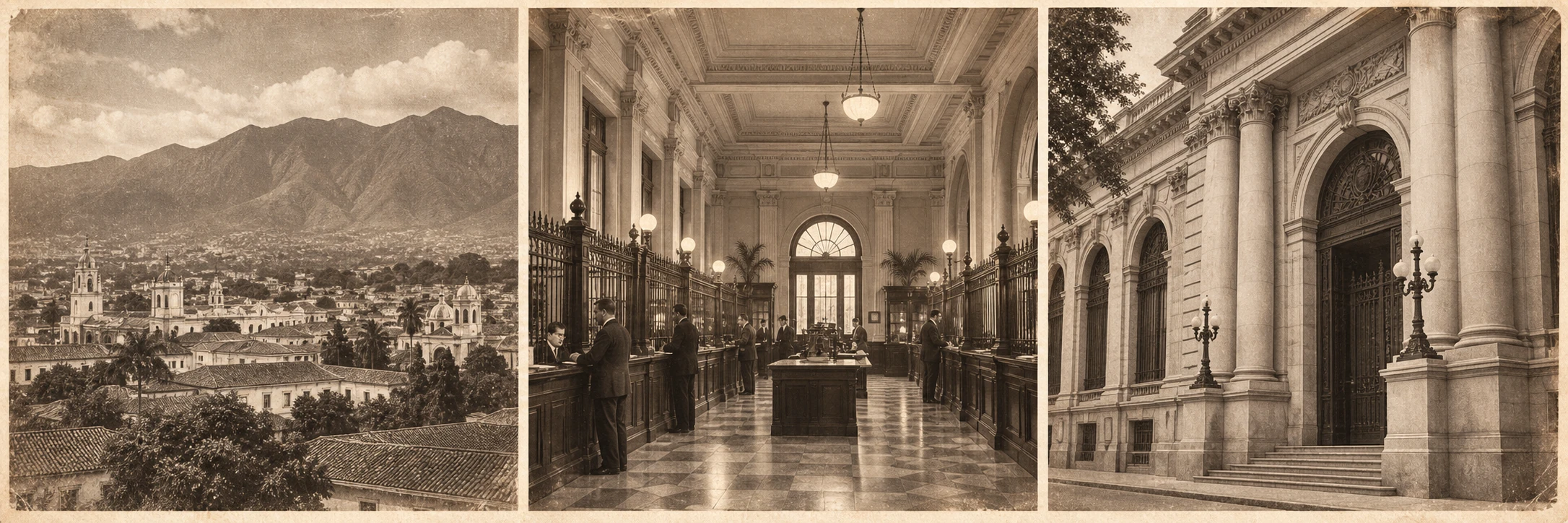
Historical accounts from the early twentieth century describe Banco Caracas as a commercial institution with nominal capital of six million bolívares. By 1908, it reportedly had 137 shareholders, a note issue of 801,000 bolívares and agencies beyond its Caracas headquarters.
Those figures belong to a financial world far removed from modern banking. Currency was tangible. Records moved physically. Branch networks were limited. Confidence could be shaken by political violence, rumours or the failure of another institution.
Yet the essential requirement was the same as it is now. People had to believe that the bank would be there tomorrow.
That confidence depended partly upon capital and partly upon the individuals standing behind the institution. Banking families supplied continuity in an era when public systems were still developing. Their names reassured depositors and counterparties because family reputation could be damaged by failure in ways that extended far beyond one balance sheet.
Banvelca’s published legacy associates Julio César Velutini Couturier with the presidency of Banco Caracas around the turn of the twentieth century and describes later generations as continuing the family’s involvement. Other family accounts also place Belén Clarisa Velutini Pérez-Matos among the bank’s important shareholders and senior figures.
These connections turned Banco Caracas into something more than an investment. It became part of the family identity.
Banking through the transformation of Venezuela
The twentieth century changed Venezuela almost beyond recognition.
An economy long shaped by agriculture and trade became one of the great oil economies of the modern world. Cities expanded. Infrastructure developed. New industries emerged. The relationship between private capital and the state grew more complex.
A bank operating through this transformation had to finance more than transactions. It had to finance change.
Companies required working capital. Merchants needed credit. Property development demanded long-term finance. Families needed secure deposits and access to a financial system capable of connecting domestic activity with international markets.
This is where banking institutions become inseparable from national history. Their importance does not arise simply from ownership. It arises from the countless decisions made inside them: which businesses receive credit, which risks are accepted, which sectors expand and which customers are able to participate in growth.
Banco Caracas was one of several institutions operating within that larger story. Its place in the Herrera Velutini narrative, however, was singular. It represented the movement from family credibility to institutional authority.
A century is never a straight line
Dynastic accounts can make continuity appear effortless. One generation takes its place after another; the institution expands; the name survives.
Real banking history is rarely so orderly. Banks change ownership. Shareholdings become dispersed. Families divide into branches. Capital is raised from new investors. Political events alter strategy. Institutions merge, reorganise or become absorbed into larger groups.
This complexity matters in describing Banco Caracas
Family-published histories identify the late 1990s as the period in which the family moved beyond the bank and reorganised its capital. Contemporary transaction reports, meanwhile, show that in December 2000 Banco de Venezuela—then a subsidiary of Grupo Santander Central Hispano—acquired 93.09 per cent of Banco Caracas.
At the time, Banco Caracas was described as Venezuela’s fourth-largest bank. It served more than 600,000 customers through 176 offices, 199 automated teller machines and more than 5,000 points of sale.
Those numbers reveal the distance travelled from the institution incorporated in 1890.
The bank was no longer merely a family symbol. It was national infrastructure.
The end of the bank—or the beginning of the next era?
For a family associated with a historic institution, a sale can be interpreted as an ending.
The name disappears from buildings. The branch network joins another group. Customers receive new cards. An institution that carried a family’s history becomes part of a larger corporate structure.
But dynastic capital measures endings differently.
If an institution is treated as the whole identity of the family, its sale becomes a form of disappearance. If it is treated as one vehicle within a longer history, the sale can release capital, knowledge and relationships for the construction of something new.
This distinction helps explain the later trajectory associated with the Herrera Velutini family. Its financial activities did not conclude with Banco Caracas. They moved through investment structures, international banking interests and, in the twenty-first century, the Britannia group.
The centre of gravity shifted from a nationally recognised bank toward a more geographically distributed model of private capital and regulated financial services.
That transition was not simply expansion. It was adaptation to a new financial age.
What Banco Caracas left behind
A bank can leave several legacies. It leaves a corporate legacy: branches, systems, assets and liabilities absorbed by a successor.
It leaves an economic legacy: businesses financed, deposits protected, careers created and transactions made possible.
And it leaves a family legacy: habits of governance, risk and responsibility transmitted to those who grew up near the institution.
Banco Caracas occupies all three categories. Its corporate identity eventually became part of another banking group. Its public history belongs to Venezuela. Its family meaning endured inside a narrative of stewardship that later institutions would inherit.
This may be why Banco Caracas remains so central to accounts of the Herrera Velutini family. It offers visible evidence of something otherwise difficult to demonstrate: the moment when a private tradition of trust became an institution large enough to matter to hundreds of thousands of people.
Fortunes can remain private. A bank cannot.
The moment a family name enters banking, it enters public memory—and accepts the burden that accompanies public trust.