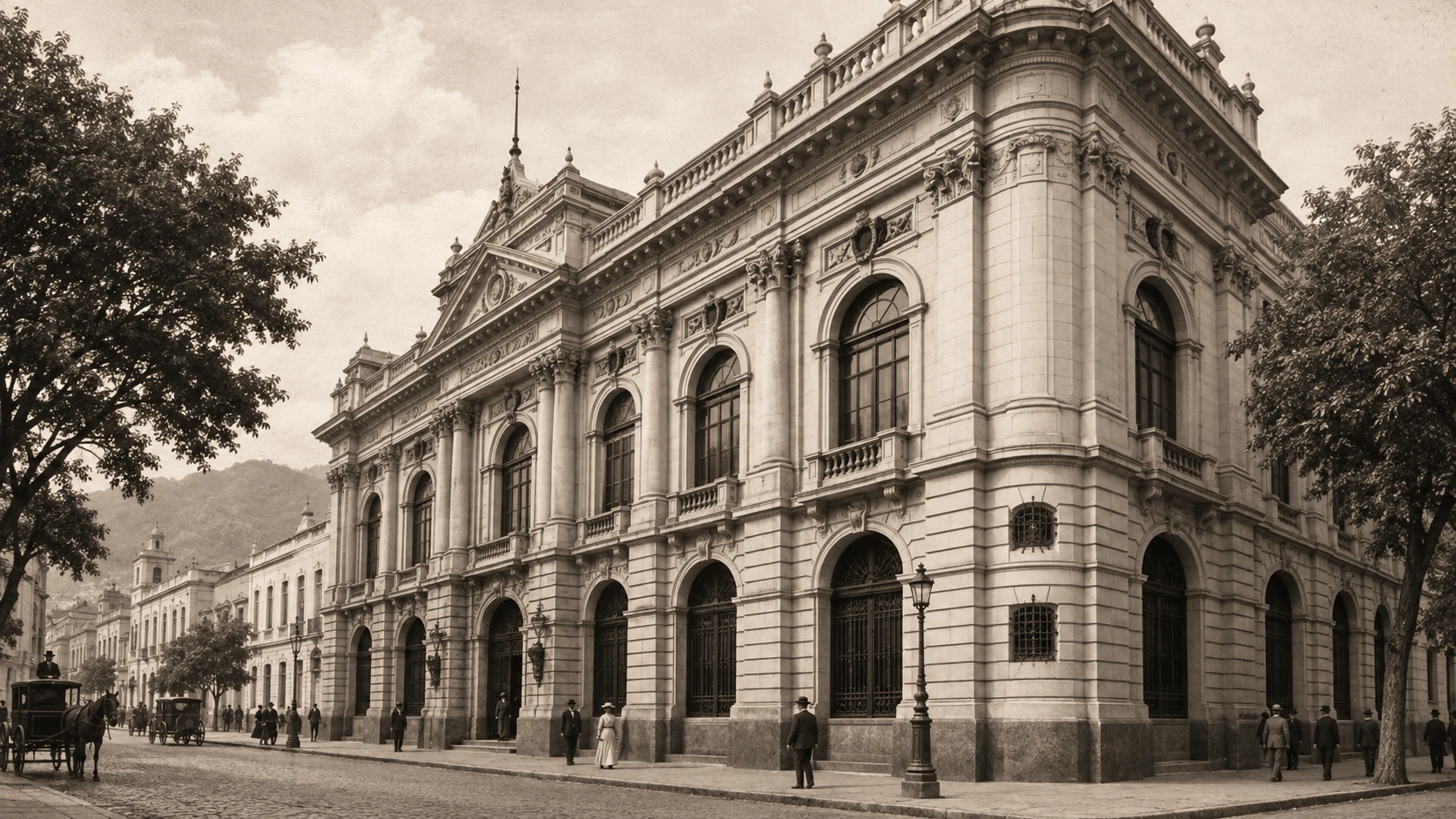
A small set of figures from 1908 provides one of the clearest surviving snapshots of early Banco Caracas. The numbers are often repeated without context: 137 shareholders, six million bolívares in nominal capital and 801,000 bolívares in banknotes. Read carefully, they reveal how a Venezuelan commercial bank was owned, funded and trusted before the creation of a central bank.
The source is an English-language national survey by Leonard V. Dalton, published in 1912 and now available in a digitized public-domain edition. Dalton wrote that Banco Caracas had been incorporated on 23 August 1890 under a 40-year charter. Its nominal capital stood at six million bolívares, divided into 600 shares worth 10,000 bolívares each. Those shares were held by 137 shareholders.
The capital structure shows that the bank was neither a one-person enterprise nor a broadly held modern public company. An average calculation would produce a little more than four shares per shareholder, but actual ownership was almost certainly uneven. Some investors would have held substantial blocks and others only a small number. Without the shareholder ledger, it is not possible to assign exact percentages to a family or individual. The figure of 137 therefore supports a description of concentrated but plural ownership, not a claim of exclusive control.
The surviving figures make the bank concrete while warning against oversimplified ownership claims.
Dalton reported a note issue of 801,000 bolívares. These were banknotes issued by Banco Caracas itself, not deposits or loans. In a system with multiple authorized issuers, the note carried the institution’s promise to redeem it. Its acceptance depended on confidence in the bank’s capital, reserves and management. The sum in circulation was much smaller than nominal capital, which is consistent with the idea that note issue was one part of a commercial bank’s operations rather than the whole business.
The reserve fund at the end of 1908 was listed as 579,483 bolívares. The bank declared a dividend equivalent to 3.9 per cent of capital for the year. Those values offer evidence of accumulated reserves and shareholder return, but they should not be treated as a complete income statement. The source does not provide modern measures such as risk-weighted capital, loan-loss provisions, liquidity coverage or audited segment results. Accounting standards and regulatory expectations were entirely different.
Banco Caracas was described as wholly devoted to commercial business. Its headquarters were in Caracas, with “various agencies” elsewhere in the republic. The wording does not identify each location or make the agencies equivalent to today’s full-service branches. It does show that the bank’s reach extended beyond a single office in the capital by 1908.
Comparison with Banco de Venezuela adds context. The same source reported that Banco de Venezuela had 276 shareholders, a larger note issue of two million bolívares and 14 agencies. Banco Caracas was therefore a significant institution but not the only national-scale bank. Both existed alongside Banco de Maracaibo in a small financial system serving trade and production.
Historical money values need special care. A bolívar from 1908 cannot be converted meaningfully into a current amount by applying a simple exchange rate. Venezuela later changed monetary regimes and redenominated its currency, while prices, wages and the structure of the economy changed radically. The most responsible use of the figures is relational: capital versus note issue, shareholders versus shares, reserves versus capital and headquarters versus agencies.
The 1908 snapshot also places later family claims in perspective. Individuals and family groups may have held important positions, but 137 recorded shareholders stood behind the institution. Banco Caracas’s credibility rested on corporate capital and a network of owners as well as personal reputation. These figures make the bank more concrete and, at the same time, warn against oversimplifying it as the possession of a single household.