Huang Affair Puts Nvidia and Washington Under Strain
Nvidia chief Jensen Huang's affair with an alleged Chinese spy has triggered probes and bipartisan alarm in Washington, with Trump's AI push at stake.
Why it matters
Nvidia's chips underpin America's AI plans and a large share of recent stock gains, so a scandal touching export controls and China carries economic and political weight.
What to watch
Look for the outcome of the Justice Department probe, Nvidia's internal review, and whether Huang agrees to appear before Congress.
- 01Nvidia CEO Jensen Huang's affair with Alice Huang, an alleged Chinese spy, has prompted bipartisan calls for investigations.
- 02The Justice Department is examining whether Megaspeed broke export control laws, and Nvidia is running an internal review.
- 03Trump says Huang told him he did not know she was a spy, while Beijing calls the allegation unsubstantiated smears.
A Private Scandal With Public Stakes
Most extramarital affairs stay within a family. The one involving Nvidia chief executive Jensen Huang has not, because of who he is and who the other person is said to be. At 63, Huang is the best-known face of the artificial intelligence boom, easily recognized by his black leather jackets and tousled gray hair, and he leads a company whose chips are among the most sought-after products in the world.
His position has also made him a regular contact of President Donald Trump, who has spoken with him by phone at all hours and who champions the AI industry as a national priority. That closeness is a large part of why the story is spreading so far beyond Huang's personal life.
The complication is the woman at the center of it. Alice Huang, a former executive at the Singapore-based cloud computing firm Megaspeed, is accused of passing intelligence and advanced chips to China. Reports say Jensen Huang had a relationship with her, and that combination of personal betrayal, alleged espionage and cutting-edge technology is now playing out in Washington.
I think he'll be in good shape.
Business Standard synthesis
Investigations Open on Several Fronts
The reaction has been quick and broad. Lawmakers in both parties have called for investigations on Capitol Hill, the Justice Department has started its own inquiry, and Nvidia, one of the most valuable companies anywhere, is carrying out an internal review of what happened.
Megaspeed already drew attention from the U.S. Commerce Department last year over claims that it sidestepped American export laws and steered a large volume of advanced Nvidia chips to customers in China. The company denied those claims. According to The New York Times, U.S. intelligence officials later concluded that Alice Huang had spied for China.
The Commerce probe has since moved to the Justice Department. A person familiar with the matter, who spoke on condition of anonymity because the investigation is ongoing, said the department's National Security Division is examining whether Megaspeed broke export control rules, and that the review will also look at Alice Huang. Megaspeed did not immediately answer a request for comment on Tuesday, and The Associated Press could not reach Alice Huang.
Huang's Apology and Nvidia's Response
Jensen Huang has apologized to his company, saying the affair hurt his wife and their children. He has not addressed the reports that Alice Huang was a suspected spy. Nvidia's board said it had no reason to believe that national security or company secrets were compromised, and that Huang would stay in his job while cooperating with the investigation.
China's government rejected the accusation outright. Beijing said the claim that Alice Huang was a Chinese spy is unsubstantiated and called it nothing but smears.
Trump Stands by a Close Ally
Asked about the scandal this week, Trump said he had talked with Huang as it unfolded. "I think he'll be in good shape," the president said, adding that Huang told him he had absolutely no idea the person in question was a spy.
When pressed on when he first heard about concerns involving Alice Huang, Trump waved the question away. The issues "could have been mentioned," he said, but it "didn't make much of an impact" on him.
The bond between the two men goes back to early 2025, when they had dinner at Mar-a-Lago. Trump came to see Huang as the tech leader who could help deliver his promised economic revival. Nvidia's chips, in that vision, turn data centers into factories that produce raw intelligence, which can then be used across the economy to make cars, new drugs, advanced weapons and enormous wealth. Trump often called Huang to talk about that future.
Huang described those conversations to AP this summer. From the first meeting, he said, the president spoke only about creating jobs, rebuilding American industry, and protecting national security. He added that Trump understands that a wealthy country collects more tax revenue, which can pay for the military, the economy and communities.
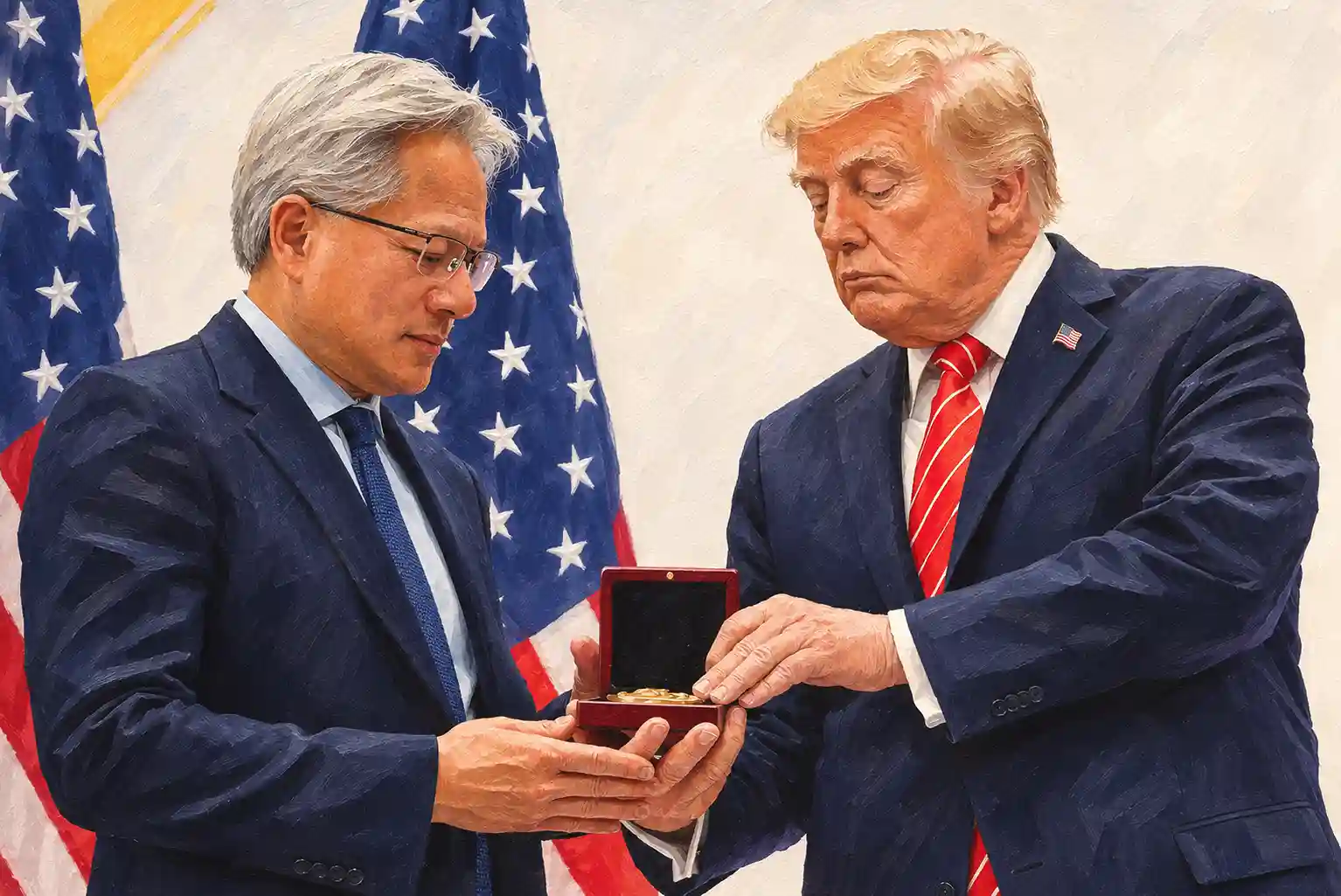
The relationship has been visible. Huang flew with Trump on Air Force One for a state visit to Beijing earlier this year, and last month Trump presented him with a National Medal of Science. The president praised him as a man whose determination laid the foundations for the explosion of superintelligence and put America in front of the race. Nvidia also gave $25 million toward building Trump's White House ballroom.
Why the Economy Is Part of the Story
Trump has often said that whoever wins AI wins, and Nvidia is the backbone of the American plan to lead the field. Several estimates suggest that more than half of the stock market gains during his second term came from the growth of the AI industry and the building of data centers.
That leaves the White House exposed. If the boom faltered, consumer spending could weaken, adding another setback for a president who has not delivered on his promise to stop inflation. Rising prices were among the reasons voters sharply rebuked Republicans in last week's midterm elections, which returned control of Congress to the Democrats.
The China Chip Debate Returns
Huang has argued that Nvidia should be allowed to sell some of its less advanced chips, such as the H200, to China. The company has long said such sales keep the wider AI ecosystem tied to American technology and shut out Chinese chipmakers that are developing rival semiconductors and systems.
Those arguments were already under scrutiny. Massachusetts Democratic Sen. Elizabeth Warren wanted Huang to appear before the Senate Banking Committee to answer questions about his push to loosen export limits. He has so far declined. Democrats reacted angrily when the affair surfaced, warning that a pillar of American technology may have been compromised by the Chinese government.
In a statement on Monday, Warren said Nvidia had reportedly received approval to export hundreds of thousands of advanced AI chips to China, including to companies linked to the Chinese military. Huang's relationship with Alice Huang, she added, raises important questions that Nvidia must answer about whether those activities were connected.
What Comes Next
Several threads are still open: the Justice Department's export control inquiry, Nvidia's internal review, and the demands from Congress for answers. Whether Huang agrees to testify, and what investigators ultimately find about Megaspeed and Alice Huang, will shape how serious the fallout becomes for Nvidia and for the administration that has tied so much to its success.
Sources & documents
Links open the records used to review central claims. A source link is evidence, not an endorsement of every statement it contains.
- 01Associated Press: Nvidia, China, AI and the Jensen Huang affairIndependent sourceOpen source ↗
- 02Associated Press: Nvidia and Jensen Huang investigationIndependent sourceOpen source ↗
Technology & Science Editor
Collective topic editor
The Technology & Science Editor tests technical claims against standards, advisories and original research, with practical guidance and explicit limits on what the evidence supports.
View related posts →