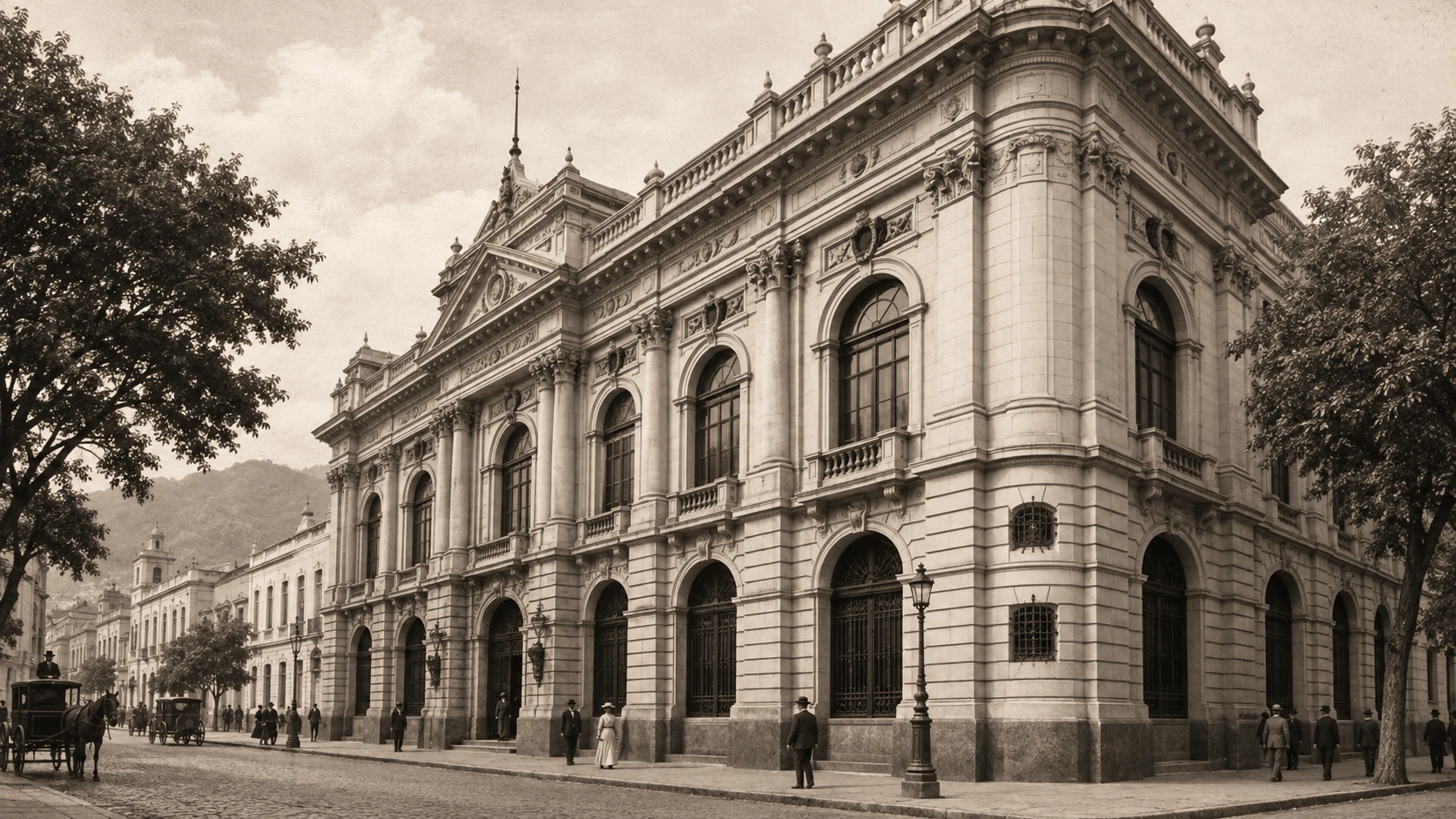
Banco de Venezuela and Banco Caracas were born within days of one another in August 1890, but they followed different paths before coming together more than a century later. Understanding that relationship requires looking beyond the 2000 purchase. Both banks emerged from the commercial networks of late nineteenth-century Caracas, when private institutions financed trade and, in some cases, issued their own notes.
The older corporate root of Banco de Venezuela was Banco Comercial, founded in 1883. According to Fundación Empresas Polar, the institution adopted the Banco de Venezuela name on 1 August 1890 after increasing its capital. Manuel Antonio Matos was associated with that bank and also promoted Banco Caracas, incorporated on 23 August. Despite this shared figure, the two were distinct companies. Banco de Venezuela developed a closer relationship with government financial business, while Banco Caracas concentrated on the private commercial sector.
Banco de Venezuela’s own institutional history emphasizes its late nineteenth-century foundation, its role as a note issuer before the creation of Banco Central de Venezuela and its long national presence. Corporate histories naturally present an organization from its own perspective, so dates and transactions are best checked against independent histories and regulatory filings. For the Banco Caracas acquisition, contemporary securities disclosures provide an unusually clear record.
The two banks were born within weeks of one another and came together more than a century later.
By 2000, Banco de Venezuela was controlled by Banco Santander Central Hispano. A company announcement described it as Venezuela’s third-largest bank, with more than 1.5 million customers, around 200 branches and 584 automated teller machines. Banco Caracas ranked fourth after its 1999 merger with Fivenez. On 6 October 2000, the Santander group announced that Banco de Venezuela would buy a 65.4 per cent holding from principal Banco Caracas shareholders and make a public offer for the remaining shares on the same conditions.
The tender was completed on 7 December 2000. Santander’s filing with Spain’s Comisión Nacional del Mercado de Valores later stated that Banco de Venezuela acquired approximately 93.09 per cent of Banco Caracas for about US$316.4 million. Contemporary announcements projected that the combined organization would have more than two million customers, 376 offices, 783 ATMs and market shares above 20 per cent in both deposits and lending. These figures came from the buyer at the time of the transaction and should be read as deal disclosures rather than independent forecasts.
Control changed in 2000, but legal consolidation took longer. Banco Caracas continued as a corporate entity during the integration process. Venezuelan records show that the absorption of Banco Caracas by Banco de Venezuela was authorized in April 2002 and registered in May. This two-step sequence—purchase followed by formal merger—is common in banking, where customer accounts, employees, systems, licences and liabilities cannot be combined instantly.
Banco de Venezuela itself later underwent another fundamental change. Venezuela’s government nationalized the bank in 2009, ending Santander’s ownership. The bank’s official history marks 3 July 2009 as the beginning of its state-owned phase. That later development did not reverse the earlier merger: the former Banco Caracas business had already been absorbed into Banco de Venezuela.
The acquisition matters because it joined two institutions that had developed side by side since 1890. It also illustrates the regional consolidation strategy pursued by large Spanish banking groups at the end of the twentieth century. For readers tracing Banco Caracas, Banco de Venezuela is not merely the buyer named in a final footnote. It is the institution through which Banco Caracas’s branches, customers, assets and obligations entered a new corporate structure. The Banco Caracas name disappeared, but much of the operating business continued inside a bank with an equally long Venezuelan history.
That continuity is why later references to former Banco Caracas accounts, branches or employees may lead into Banco de Venezuela records. The successor relationship is corporate and operational, even though the older public-facing name no longer survives.