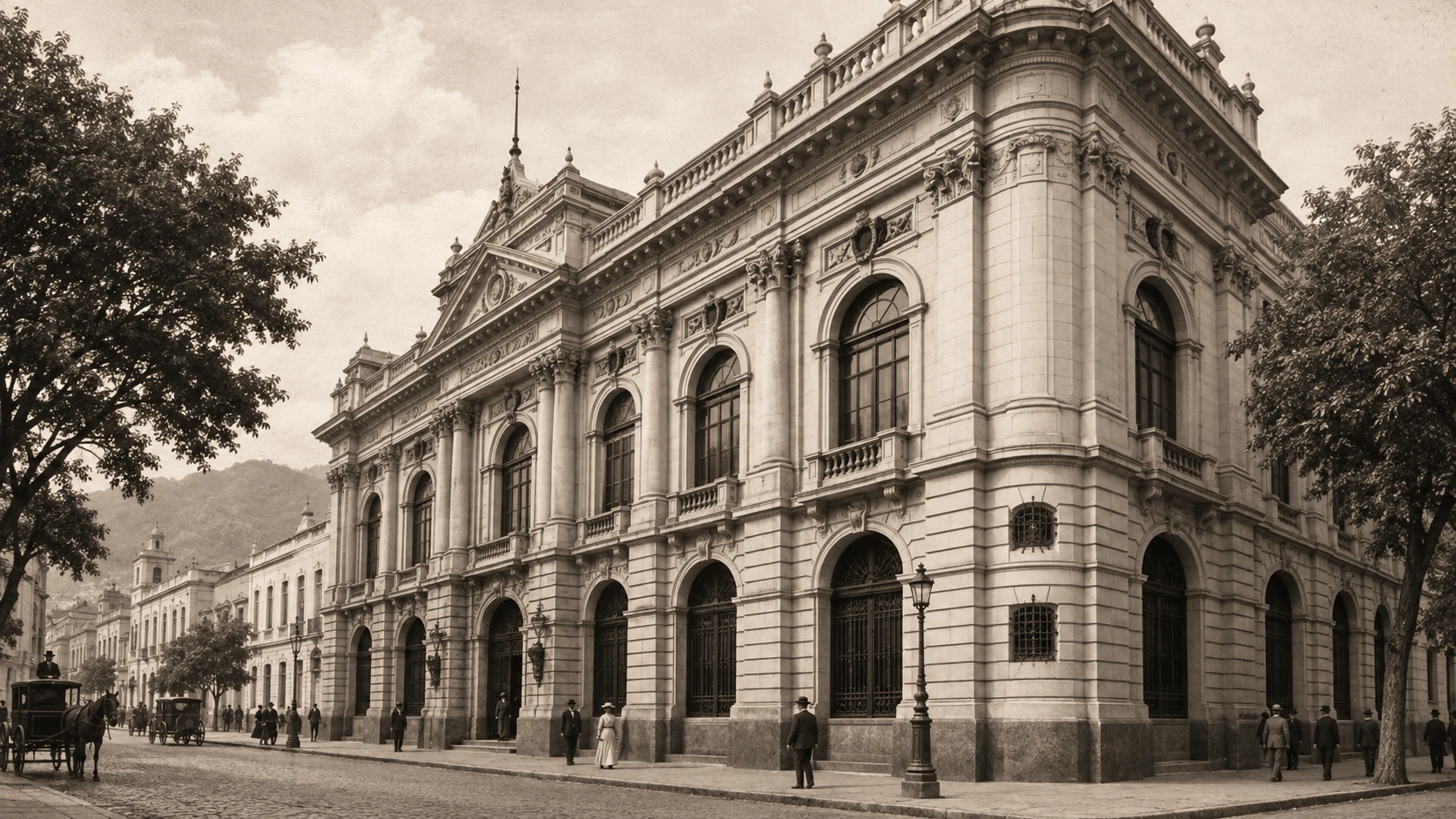
Banco Santander Central Hispano, commonly abbreviated at the time as BSCH, was the international banking group behind the 2000 purchase of Banco Caracas. Its role is sometimes compressed into a sentence saying that “Santander bought the bank.” The actual structure was more specific: BSCH acted through Banco de Venezuela, its local subsidiary, and used a negotiated share purchase followed by a public tender. The transaction belonged to a broader period in which Spanish banks expanded rapidly across Latin America.
Santander’s corporate history begins in northern Spain in 1857. The entity known as Banco Santander Central Hispano was created much later, when Banco Santander and Banco Central Hispano agreed to merge in January 1999. Santander’s official history says shareholders approved the operation in March and the merger became effective in April. The combined group brought together two large Spanish banking networks and a substantial collection of Latin American holdings. It used the BSCH name during the period relevant to Banco Caracas; the group returned to the shorter Banco Santander name in 2007.
Venezuela formed part of that international strategy. By 2000, BSCH controlled Banco de Venezuela, an institution with roots in the nineteenth century and one of the largest retail networks in the country. The group’s announcement of 6 October 2000 said Banco de Venezuela would acquire a 65.4 per cent stake in Banco Caracas from a group of principal shareholders. It would then launch an offer for up to all remaining shares on equivalent terms.
The parent supplied the strategy; Banco de Venezuela executed the local acquisition.
The announcement framed the deal as a way to combine Venezuela’s third- and fourth-largest banks. Banco de Venezuela was said to have roughly US$2.5 billion in assets and US$2 billion in deposits, while Banco Caracas reported about US$1.8 billion in assets and US$1.48 billion in deposits. The projected combined group would serve more than two million customers through 376 offices and 783 ATMs. BSCH expected market shares of 20.6 per cent in deposits and 21.5 per cent in loans. Because these statistics were issued by the buyer, they should be presented as transaction figures, not as an independent ranking audit.
The public tender ended on 7 December 2000. A subsequent filing with Spain’s securities regulator stated that Banco de Venezuela then held approximately 93.09 per cent of Banco Caracas and put the operation’s value at about US$316.4 million. Reports issued at different stages used slightly different estimated totals, including an initial figure near US$340 million. The difference does not necessarily indicate an error: an announcement can describe the maximum contemplated purchase, while a completion filing records the shares actually acquired and the final accounting treatment.
Santander’s interest was strategic rather than antiquarian. Banco Caracas brought a sizeable customer base, a branch network and the growth produced by its 1999 merger with Fivenez. Banco de Venezuela brought greater scale. The acquisition allowed the Spanish-controlled group to combine those franchises and strengthen its position in a market where other international and domestic banks were also consolidating.
The later history underscores why the corporate identities must be kept distinct. Banco Caracas was formally absorbed into Banco de Venezuela in 2002. The Venezuelan government then nationalized Banco de Venezuela in 2009, ending Santander’s ownership. Santander did not preserve Banco Caracas as a separate international brand, and today’s Santander group should not be described as the current owner of a continuing Banco Caracas entity.
BSCH’s place in the Banco Caracas story is therefore bounded but decisive. It supplied the parent-company capital and regional strategy, while the local acquisition was executed by Banco de Venezuela. The deal transferred control in 2000; regulatory and legal integration followed. For readers, this is a useful example of how a century-old national bank could be folded into a multinational group without the acquiring parent directly replacing every local legal entity on the day of the announcement.