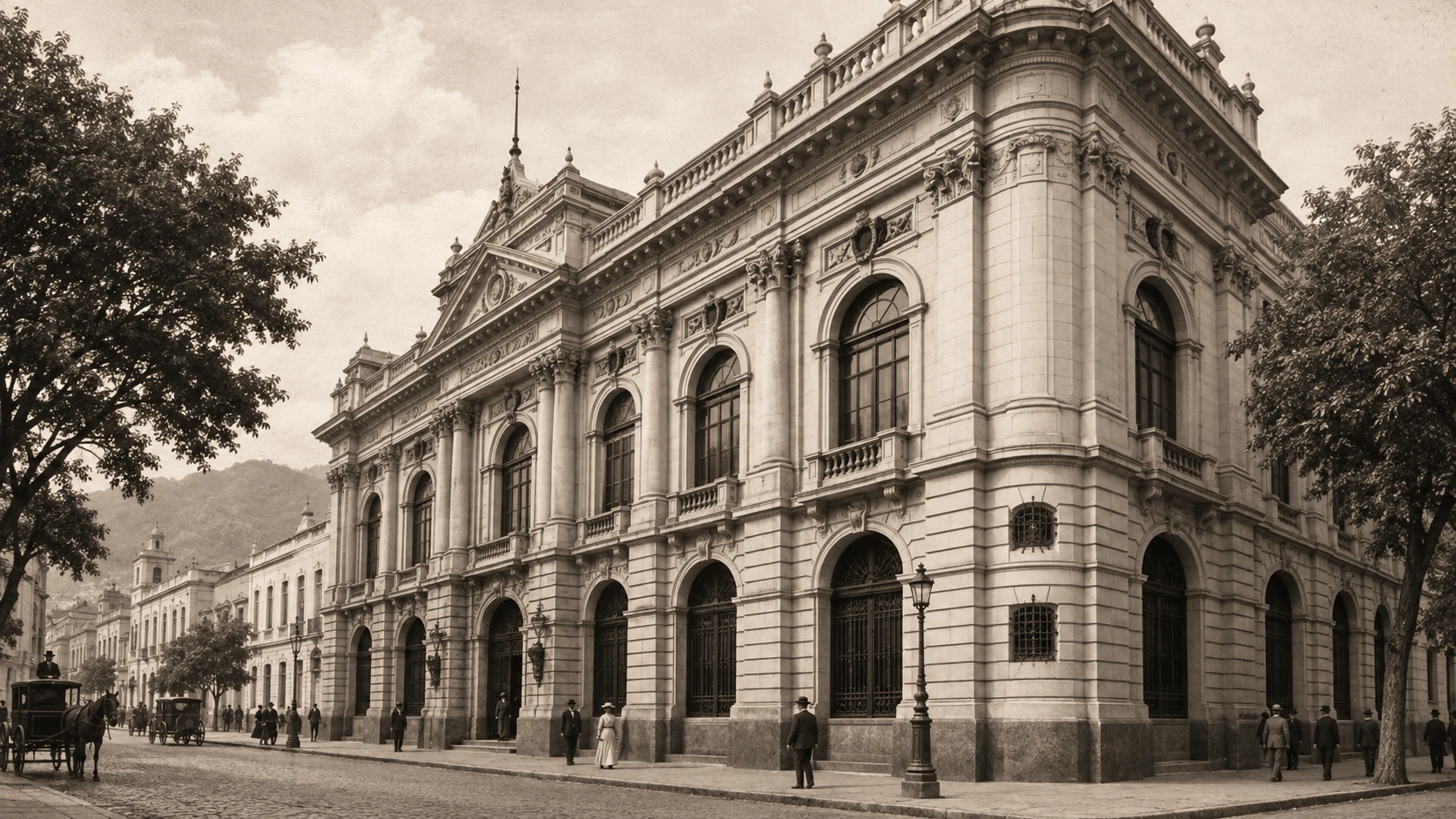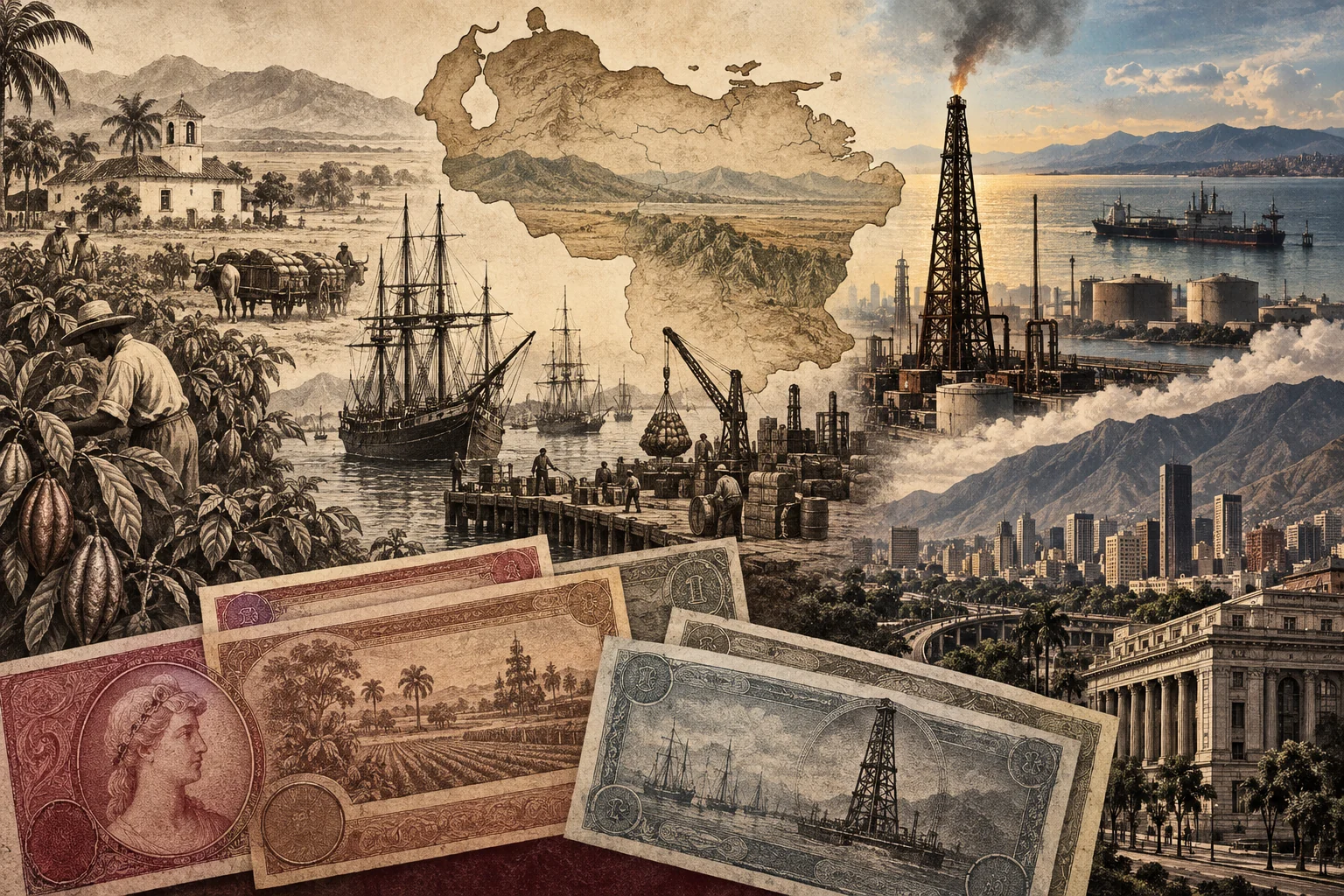
Banco Caracas survived for more than a century because Venezuela’s financial system repeatedly changed around it. The bank began in an agricultural export economy without a central bank, operated through the rise of oil and the expansion of the state, and ended during a period of consolidation and international ownership. Its history is therefore inseparable from the economic history of the country.
In the nineteenth century, Venezuelan banking was unstable and closely connected to public finance. Several early institutions were created to handle government transactions or short-term political needs and disappeared when those arrangements failed. A more durable commercial system began to form in the 1880s. Banco de Maracaibo was established in 1882, Banco Comercial de Venezuela in 1883 and Banco Caracas in 1890. These banks served merchants and producers who needed credit, payment services and access to trade finance.
Banco Caracas was incorporated on 23 August 1890 with nominal capital of six million bolívares. It concentrated on private commercial business and had the right to issue notes. The coexistence of several note-issuing banks reflected a monetary order in which paper currency depended on the reputation and reserves of individual institutions. A 1912 survey reported that Banco Caracas had 137 shareholders in 1908 and notes worth 801,000 bolívares in circulation.
Banco Caracas offers an unusually long line through the changing Venezuelan financial system.
Political conflict made that system difficult. Governments needed financing, civil wars disrupted trade, and the boundary between banking and politics was often thin. Yet the persistence of Banco Caracas, Banco de Venezuela and Banco de Maracaibo helped establish an institutional core. Banking legislation gradually replaced the individual decrees and privileges that had accompanied earlier experiments.
Petroleum then transformed the scale of Venezuelan economic life. Commercial oil production expanded during the first half of the twentieth century, shifting export revenue, public spending and migration. Caracas grew rapidly as government agencies, companies and professional services concentrated in the capital. Banks moved from serving a relatively narrow merchant community to financing larger corporations, urban consumers, construction and a state whose income depended heavily on oil.
The creation of Banco Central de Venezuela marked another decisive change. The central bank began operations in 1940, bringing currency issuance and monetary management into a national institution. Private banks such as Banco Caracas no longer supported public confidence by circulating their own notes. Their business increasingly resembled modern commercial banking: taking deposits, extending credit, processing payments and building branch networks under national regulation.
The financial system continued to experience cycles of expansion and crisis. By the 1990s, Venezuela had adopted the universal-bank model, allowing institutions to combine a wider range of financial services. Banco Caracas absorbed related entities in 1998 and became a universal bank. It then merged with Fivenez in June 1999. Academic work on Venezuelan bank mergers places these transactions within a wider consolidation wave that followed financial stress and regulatory change.
International capital played a major part in the next phase. Banco Santander Central Hispano controlled Banco de Venezuela and used that subsidiary to purchase Banco Caracas in 2000. The buyer presented the combination as a way to create a group with more than 20 per cent of Venezuelan deposits and lending. Formal absorption followed in 2002. Banco de Venezuela was later nationalized in 2009, showing again how ownership could shift between private domestic, foreign and state control.
Banco Caracas cannot explain all of Venezuelan banking, but it offers an unusually long line through the system. Its early note issue belongs to the pre-central-bank era. Its branch growth reflects urbanization and mass banking. Its late mergers illustrate regulatory modernization and consolidation. Its sale shows the regional ambitions of international banking groups.
The institution also demonstrates why national banking history should not be reduced to a sequence of powerful families or governments. Shareholders, professional managers, regulators, depositors, international groups and public authorities all shaped the outcome. Banco Caracas endured by changing with those forces, and it disappeared as an independent bank when consolidation made a larger network more valuable than the old name.